


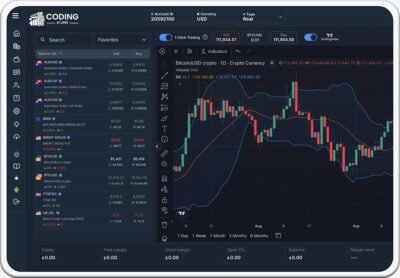





What Is Forex Client Onboarding?
Forex client onboarding is the complete process of registering, verifying, approving, and activating a new client so they can start trading on a forex brokerage platform. It is one of the most critical operational processes for every regulated broker because it directly impacts customer experience, regulatory compliance, conversion rates, and long-term client retention.
A successful onboarding process does much more than create a trading account. It confirms the client’s identity, ensures compliance with anti-money laundering (AML) regulations, evaluates potential risks, and prepares the client to begin trading securely. Every step must be completed accurately while minimizing delays that could cause potential traders to abandon the registration process.
In today’s competitive trading industry, clients expect a fast and seamless digital experience. They want to open an account, verify their identity, fund their wallet, and access trading platforms such as MT4 or MT5 within minutes. If the onboarding process is slow, confusing, or requires excessive manual intervention, many prospective clients leave before completing registration. This is why modern brokerages are investing in automated forex client onboarding solutions that combine CRM systems, KYC verification, AML screening, workflow automation, and AI-powered technologies.
Why Forex Client Onboarding Matters
Client onboarding is often the first real interaction a trader has with a brokerage. A smooth onboarding experience creates confidence and establishes trust from the beginning. On the other hand, complicated forms, repeated document requests, or long approval times can create frustration and increase abandonment rates.
An effective forex client onboarding process helps brokerages:
- Deliver a professional first impression.
- Meet regulatory and compliance requirements.
- Reduce manual administrative work.
- Accelerate account approvals.
- Improve client conversion rates.
- Minimize fraud and identity theft.
- Increase operational efficiency.
- Support business growth without significantly increasing staff.
For brokers operating across multiple countries, onboarding is even more important because different jurisdictions require different compliance checks, document types, and verification procedures. A well-designed onboarding workflow ensures that every client is processed according to the applicable regulatory standards.
The Typical Forex Client Onboarding Process
Although every brokerage has its own workflow, most follow these key steps.
Step 1: Account Registration
The client registers through the broker’s website or app by providing:
- Full name
- Email address
- Phone number
- Country
- Account type
- Password
An email or SMS verification is then sent.
Step 2: Personal Information Collection
Additional details may include:
- Date of birth
- Residential address
- Nationality
- Employment
- Financial information
- Trading experience
- Investment objectives
This information supports regulatory compliance.
Step 3: Identity Verification (KYC)
Clients upload identity documents such as:
- Passport
- National ID card
- Driver’s license
AI, OCR, and facial recognition verify the documents automatically.
Step 4: Address Verification
Clients submit proof of address, including:
- Utility bill
- Bank statement
- Government document
- Tax document
This confirms the declared residential address.
Step 5: AML and Sanctions Screening
The system performs:
- Sanctions screening
- PEP checks
- Adverse media screening
- Risk scoring
- Watchlist monitoring
High-risk applications are flagged for review.
Step 6: Compliance Review
Low-risk clients are often approved automatically, while higher-risk cases are reviewed by compliance officers.
After approval, the system automatically:
- Creates an MT4/MT5 account
- Sets leverage
- Assigns account currency
- Links the CRM
- Activates the client portal
- Enables the wallet
Automation speeds up account creation.
Step 8: Funding and Account Activation
Clients fund their accounts using:
- Bank transfers
- Credit/debit cards
- E-wallets
- Cryptocurrency (where permitted)
After the first deposit, the trading account becomes fully active.
Traditionally, many forex brokers relied on manual processes involving spreadsheets, emails, paper documents, and multiple internal teams. This often resulted in long approval times, inconsistent compliance checks, and a poor customer experience.
Today, automated forex client onboarding connects every stage of the journey into a single workflow. Registration, identity verification, AML screening, CRM updates, account creation, payment processing, and client communication are handled through integrated systems with minimal manual intervention.
The result is a faster, more secure, and highly scalable onboarding process that benefits both the brokerage and its clients. As competition in the forex industry continues to grow, automation has become a strategic necessity rather than a convenience.
In the next section, we will examine why traditional manual onboarding processes fail and how these challenges impact compliance, operational efficiency, and client acquisition.
Manual vs Automated Forex Client Onboarding
| Process | Manual Onboarding | Automated Onboarding |
| Registration | Paper forms or lengthy online forms | Fast digital registration |
| Identity Verification | Manual document review | AI-powered KYC verification |
| AML Screening | Performed manually | Instant automated screening |
| Data Entry | Repeated across systems | Automatic synchronization |
| Trading Account Creation | Manual setup | Instant account provisioning |
| Client Communication | Email-based | Automated email, SMS, and notifications |
| Approval Time | Hours or days | Minutes for most low-risk clients |
| Error Rate | Higher | Significantly reduced |
| Operational Cost | High | Lower over time |
| Scalability | Limited | Supports large client volumes |
Key Takeaway
Manual forex client onboarding may have been sufficient in the past, but it can no longer meet the expectations of modern traders or the operational demands of growing brokerages. Slow approvals, repetitive tasks, compliance bottlenecks, human errors, and disconnected systems all reduce efficiency and increase client drop-off.
Automating the onboarding process enables brokers to deliver faster account activation, strengthen regulatory compliance, reduce operational costs, and provide a seamless client experience. In the next section, we’ll explore the key business benefits of automated forex client onboarding and why it has become a strategic investment for modern brokerages.
Benefits of Automated Forex Client Onboarding
Automated forex client onboarding helps brokerages deliver faster, more secure, and compliant account opening while reducing manual work. By connecting CRM, KYC, AML, payment gateways, and trading platforms, brokers can improve both efficiency and customer experience.

1. Faster Account Opening
AI automates verification, compliance checks, and account creation, reducing approval time from days to minutes.
2. Improved Regulatory Compliance
Automates KYC, AML, sanctions screening, PEP checks, risk scoring, and audit records for consistent compliance.
3. Better Customer Experience
Provides simple registration, faster approvals, secure uploads, and real-time status updates.
4. Higher Conversion Rates
Short forms, automated verification, and reminders reduce abandonment and increase completed registrations.
5. Reduced Operational Costs
Automation minimizes manual tasks, allowing teams to handle more clients with fewer resources.
6. Greater Accuracy
Eliminates duplicate entries, validates data automatically, and reduces human errors.
7. Stronger Fraud Prevention
Uses AI, OCR, facial recognition, liveness detection, and risk analysis to detect fraudulent applications.
8. Seamless System Integration
Connects Broker CRM, KYC, AML, MT4/MT5, payment gateways, and client portals through APIs.
9. Easy Scalability
Supports multiple brands, regions, languages, and high client volumes without increasing staff.
10. Faster Deposits and Trading
Quicker approvals help clients fund accounts and begin trading sooner.
11. Better Client Engagement
Automates welcome emails, KYC reminders, trading guides, deposit reminders, and personalized follow-ups.
12. Actionable Insights
Tracks KPIs such as onboarding time, KYC approval, conversion rates, first deposits, compliance, and client retention to optimize performance.
Summary of Key Benefits
| Business Area | Benefit of Automated Forex Client Onboarding |
| Client Experience | Faster, simpler, and more user-friendly onboarding |
| Compliance | Consistent KYC, AML, and regulatory workflows |
| Operations | Reduced manual work and improved efficiency |
| Cost Management | Lower staffing and operational expenses |
| Revenue | Faster client activation and earlier deposits |
| Security | Stronger fraud detection and identity verification |
| Scalability | Supports business growth without operational bottlenecks |
| Data Accuracy | Eliminates duplicate entries and manual errors |
| CRM Integration | Creates a connected brokerage ecosystem |
| Analytics | Provides real-time performance and compliance insights |
Key Takeaway
Automated forex client onboarding is no longer just an operational improvement. It is a strategic investment that helps brokerages improve compliance, reduce costs, strengthen security, and deliver a superior client experience. By replacing repetitive manual tasks with intelligent workflows, brokers can onboard clients faster, activate trading accounts more efficiently, and scale their business with confidence.
Understanding the Complete Forex Client Onboarding Workflow
A modern forex client onboarding workflow combines Broker CRM, KYC, AML, payment gateways, trading platforms, client portals, and back-office systems into one automated process. This reduces manual work, speeds up approvals, improves compliance, and enhances the client experience.
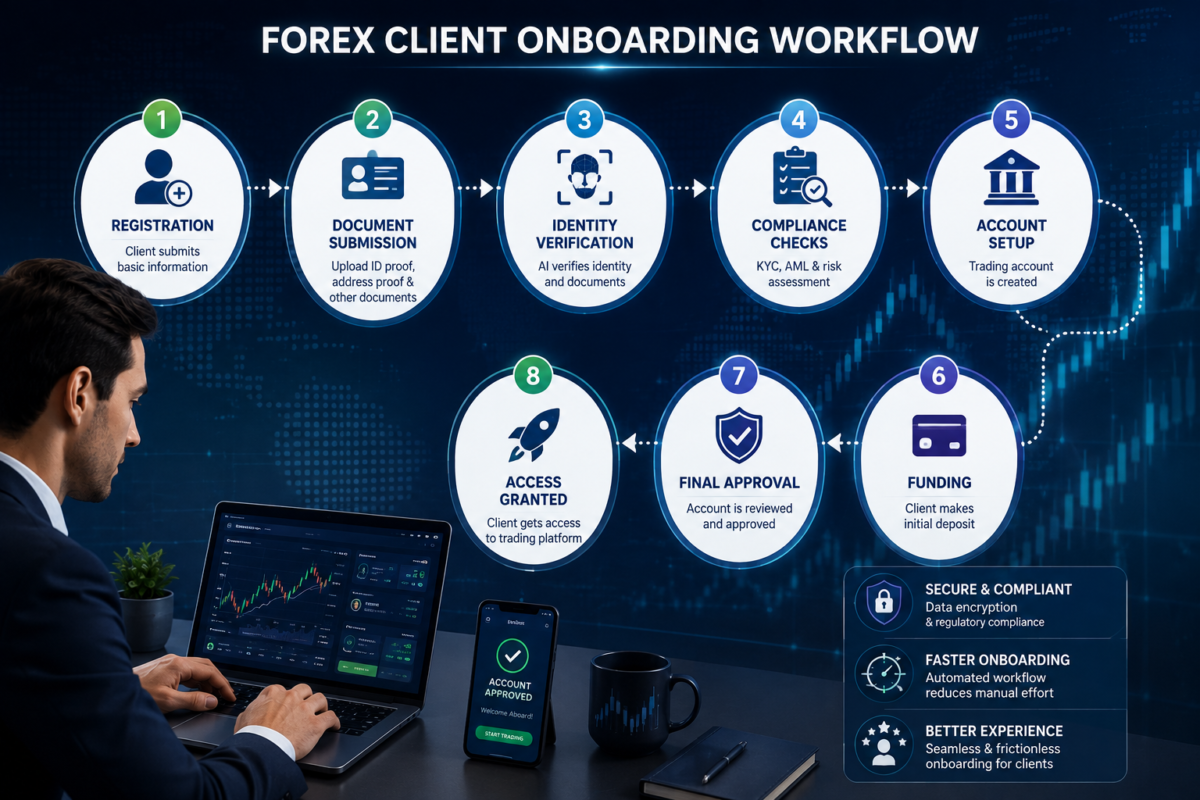
Step 1: Client Registration
Clients register by providing basic details. The CRM creates a client profile and starts the onboarding workflow.
Step 2: Email & Phone Verification
Email verification links and OTPs confirm contact details and prevent fake registrations.
Step 3: Client Profile Completion
Clients submit additional information such as address, nationality, employment, income, trading experience, and source of funds.
Step 4: Document Upload
Identity and proof of address documents are uploaded, validated, and processed using OCR.
Step 5: Automated KYC Verification
AI verifies document authenticity, facial matching, expiry dates, and detects fraud or duplicate identities.
Step 6: AML & Risk Screening
The system performs sanctions, PEP, watchlist, adverse media checks, and assigns a risk score.
Step 7: Compliance Approval
Low-risk clients are approved automatically, while complex applications go to compliance teams.
Step 8: Trading Account Creation
The system creates MT4/MT5 accounts, configures settings, and links them with the CRM.
Step 9: Client Portal Activation
Clients receive secure access to manage accounts, upload documents, and request withdrawals.
Step 10: Payment & Wallet Setup
Clients fund accounts through supported payment methods, with balances updating automatically.
Step 11: Welcome Communication
Automated emails, login details, MT4/MT5 guides, and onboarding resources are sent instantly.
Step 12: Sales & Relationship Management
The CRM tracks client activity, triggers reminders, assigns sales tasks, and launches personalized follow-up campaigns.
End-to-End Automated Forex Client Onboarding Workflow
Visitor Lands on Website
│
▼
Account Registration
│
▼
Email & Phone Verification
│
▼
Complete Personal Profile
│
▼
Upload Identity Documents
│
▼
AI-Based KYC Verification
│
▼
AML & Risk Screening
│
▼
Compliance Approval
│
▼
Trading Account Creation
│
▼
Client Portal Activation
│
▼
Deposit & Wallet Setup
│
▼
Welcome Email & Platform Access
│
▼
Sales Follow-up & Client Engagement
Why This Workflow Matters
A fully automated onboarding workflow creates a connected ecosystem where every system communicates seamlessly with the next. Instead of relying on emails, spreadsheets, and manual approvals, brokerages can process thousands of applications quickly while maintaining high standards of compliance and security.
The result is:
- Faster client activation
- Lower operational costs
- Improved regulatory compliance
- Better customer satisfaction
- Reduced fraud risk
- Higher conversion rates
- Greater scalability
- Increased operational efficiency
As brokerages continue to expand globally, adopting an automated forex client onboarding workflow is no longer optional. It has become a competitive advantage that enables firms to onboard more clients, deliver a superior digital experience, and support long-term business growth.
Essential Technologies for Automated Forex Client Onboarding
A successful forex client onboarding process relies on an integrated technology ecosystem. Connecting CRM, KYC, AML, payment gateways, trading platforms, and communication tools reduces manual work, improves compliance, and speeds up account activation.
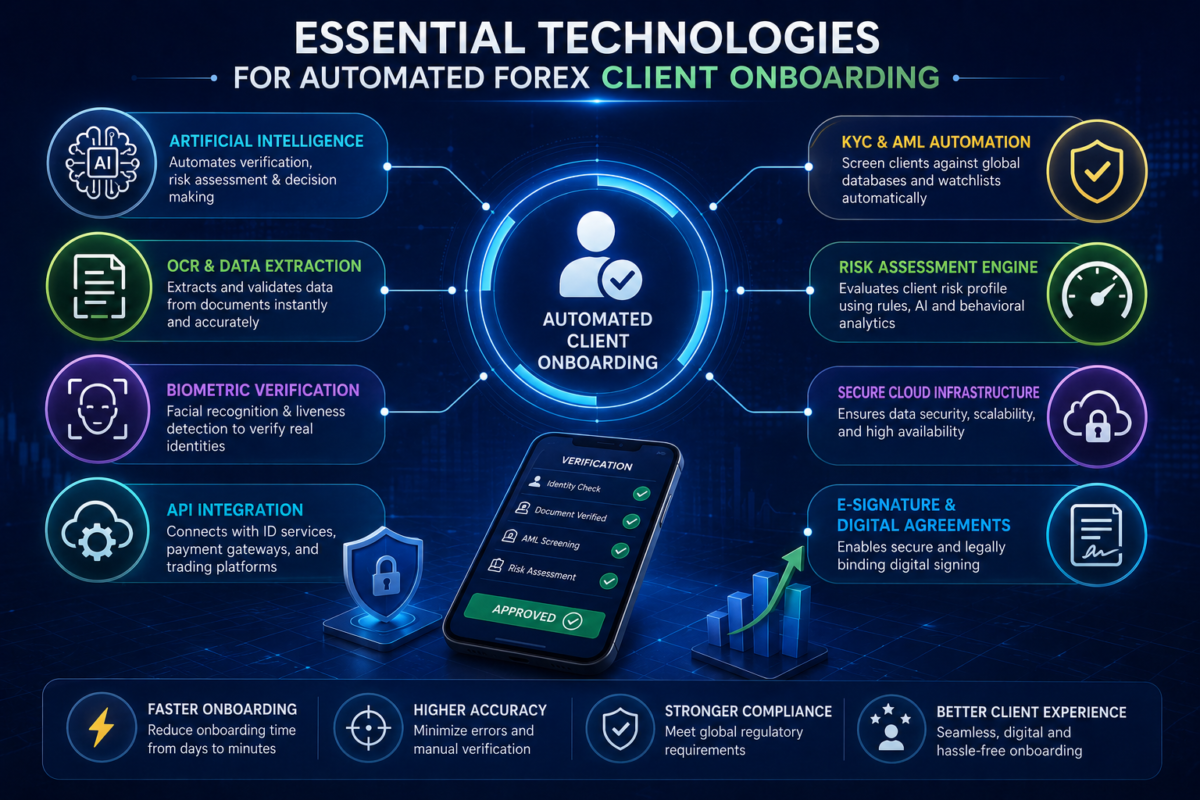
1. Broker CRM
Manages client profiles, onboarding progress, workflows, communication, reporting, and API integrations.
2. KYC Verification Software
Uses AI and OCR to verify passports, IDs, driver’s licenses, face matching, and document authenticity.
3. AML Screening System
Performs sanctions checks, PEP screening, watchlist monitoring, adverse media checks, and risk scoring.
4. OCR Technology
Extracts customer data from identity documents and syncs it with the CRM automatically.
5. Artificial Intelligence (AI)
Automates identity verification, fraud detection, risk scoring, workflow routing, chatbots, and personalized onboarding.
6. Client Portal
Allows clients to register, upload documents, manage accounts, make deposits, and contact support.
7. Back Office Software
Helps teams review applications, manage compliance, process payments, and generate reports.
8. Trading Platform Integration
Automatically creates MT4/MT5/cTrader accounts and configures account settings.
9. Payment Gateway Integration
Supports secure deposits and instantly updates CRM and trading systems.
10. Communication Tools
Automate emails, SMS, OTPs, KYC reminders, approvals, and welcome notifications.
11. Workflow Automation Engine
Triggers each onboarding step automatically from registration to account activation.
12. API Integration Layer
Connects CRM, KYC, AML, trading platforms, payment gateways, and analytics.
13. Document Management System
Securely stores client documents with encryption, backups, and access controls.
14. Analytics & Reporting
Tracks KPIs such as onboarding time, KYC approval, conversion rates, and compliance performance.
How These Technologies Work Together
Below is a simplified view of how the technology ecosystem supports automated forex client onboarding.
Client Registration
│
▼
Broker CRM
│
▼
Email & SMS Verification
│
▼
KYC Verification System
│
▼
AML Screening Platform
│
▼
Compliance Approval
│
▼
Trading Platform (MT4 / MT5)
│
▼
Payment Gateway
│
▼
Client Portal
│
▼
Marketing Automation
│
▼
Analytics & Reporting
Choosing the Right Technology Stack
When evaluating onboarding technologies, brokerages should look for solutions that offer:
- API-first architecture
- Cloud scalability
- Strong security and encryption
- Regulatory compliance support
- Real-time synchronization
- Multi-language capabilities
- Multi-currency support
- Customizable workflows
- Mobile-friendly interfaces
- Comprehensive reporting
Selecting technology that integrates seamlessly across the brokerage ecosystem reduces operational complexity and prepares the business for future growth.
Key Takeaway
Automated forex client onboarding is powered by a combination of interconnected technologies rather than a single software solution. A Broker CRM, KYC verification platform, AML screening system, AI tools, payment gateway, trading platform, client portal, and workflow automation engine all play a vital role in delivering a fast, secure, and compliant onboarding experience.
When these technologies work together, brokerages can significantly reduce manual effort, improve regulatory compliance, accelerate client activation, and scale their operations with confidence.
How AI Improves Forex Client Onboarding
Artificial Intelligence (AI) makes forex client onboarding faster, more accurate, and secure by automating verification, compliance, fraud detection, and customer communication.
1. AI-Powered Identity Verification
Verifies IDs, detects fake documents, matches selfies, and identifies duplicate identities for faster approvals.
2. Intelligent OCR
Extracts customer details such as name, passport number, address, and expiry date, then syncs them with the Broker CRM.
3. Fraud Detection
Detects fake documents, identity theft, suspicious IPs, duplicate registrations, and unusual behavior.
4. Facial Recognition
Uses selfie matching and liveness detection to prevent deepfakes, printed photos, and replay attacks.
5. Intelligent Risk Scoring
Evaluates country, AML results, PEP status, source of funds, and other risk factors to automate approvals.
6. Compliance Decision Support
Recommends approvals, requests documents, prioritizes reviews, and flags high-risk applications.
7. AI Chatbots
Provide instant support for KYC, verification, deposits, MT5 setup, and password assistance.
8. Personalized Onboarding
Delivers preferred language, suitable account types, educational content, and personalized offers.
9. Automated Communication
Sends registration confirmations, KYC reminders, approval updates, deposit reminders, and welcome emails.
10. Predictive Analytics
Identifies drop-offs, high-value clients, compliance risks, and workflow bottlenecks.
11. Multilingual Support
Assists global clients with registration, compliance, and onboarding in multiple languages.
12. Continuous Learning
AI continuously improves fraud detection, risk scoring, workflow automation, and customer support.
Traditional vs AI-Powered Forex Client Onboarding
| Process | Traditional Onboarding | AI-Powered Onboarding |
| Document Review | Manual | Automated using AI |
| Data Entry | Manual typing | OCR with AI extraction |
| Identity Verification | Human review | AI verification and face matching |
| Fraud Detection | Limited | Real-time intelligent analysis |
| Risk Assessment | Rule-based | Dynamic AI risk scoring |
| Customer Support | Business hours | 24/7 AI chatbot assistance |
| Communication | Manual emails | Automated personalized messaging |
| Approval Time | Hours or days | Minutes for most low-risk clients |
| Scalability | Staff-dependent | Highly scalable |
Best Practices for Using AI in Client Onboarding
To maximize the benefits of AI, brokerages should follow these best practices:
- Combine AI with human compliance oversight.
- Continuously monitor AI performance and accuracy.
- Keep AI models updated with evolving fraud patterns.
- Maintain transparent audit trails for regulatory inspections.
- Protect customer data using encryption and secure storage.
- Ensure AI decisions comply with applicable regulations.
- Regularly review and optimize onboarding workflows.
AI should enhance compliance processes rather than replace human judgment, especially for high-risk or complex cases.
Key Takeaway
Artificial Intelligence is reshaping forex client onboarding by making identity verification, compliance checks, fraud detection, customer communication, and risk assessment faster and more intelligent. By automating repetitive tasks while supporting human decision-making, AI enables brokerages to onboard clients more efficiently, reduce operational costs, and provide a superior customer experience.
As AI technology continues to evolve, brokerages that adopt intelligent onboarding solutions will be better positioned to scale their operations, strengthen compliance, and stay ahead in an increasingly competitive forex market.
CRM Automation Workflow for Forex Client Onboarding
A Broker CRM is the operational backbone of modern forex client onboarding. While KYC providers verify identities and AML systems perform compliance checks, the CRM connects every stage of the onboarding journey into a single automated workflow.
Without CRM automation, sales teams, compliance officers, customer support, and operations departments often work in separate systems. This results in duplicate data entry, communication gaps, delayed approvals, and inconsistent customer experiences.
With a modern Broker CRM, every action is automatically tracked, synchronized, and triggered based on predefined rules. From the moment a visitor registers until they become an active trader, the CRM manages the entire customer lifecycle.
Let’s explore how a complete CRM automation workflow works.
Why CRM Automation Is Essential
The primary purpose of CRM automation is to eliminate repetitive manual tasks while ensuring every client follows a standardized onboarding process.
Instead of employees manually updating spreadsheets or sending follow-up emails, the CRM performs these actions automatically.
CRM automation helps brokerages:
- Accelerate client onboarding
- Improve sales productivity
- Reduce compliance delays
- Minimize manual errors
- Increase first-time deposits
- Enhance customer engagement
- Improve conversion rates
- Scale operations efficiently
Complete CRM Automation Workflow
Below is a typical workflow used by modern forex brokerages.
Website Visitor
│
▼
Registration Form Submitted
│
▼
CRM Creates New Lead
│
▼
Email & Phone Verification
│
▼
Lead Qualification
│
▼
Document Upload
│
▼
KYC Verification
│
▼
AML Screening
│
▼
Compliance Approval
│
▼
MT4 / MT5 Account Creation
│
▼
First Deposit
│
▼
Welcome Campaign
│
▼
Sales Follow-up
│
▼
Active Trader
Step 1: Lead Creation
When a visitor registers, the CRM automatically:
- Creates a client record
- Assigns a customer ID
- Stores registration details
- Records the lead source
- Starts the onboarding workflow
Common lead sources:
- Google Search
- Facebook Ads
- Affiliate Partners
- Introducing Brokers (IBs)
- Referral Programs
- Organic Traffic
Tracking lead sources helps measure marketing performance.
Step 2: Automatic Lead Assignment
The CRM automatically assigns leads based on:
- Country
- Language
- Time zone
- Account type
- Deposit potential
- Team workload
- VIP status
This ensures faster responses and personalized service.
Step 3: Automated Communication
After registration, clients automatically receive:
- Registration confirmation
- Email/OTP verification
- Welcome message
- Account activation instructions
- KYC requests
Communication channels include:
- SMS
- Push notifications
- In-app notifications
Step 4: KYC Workflow Automation
Uploaded documents are automatically sent for verification.
The CRM tracks:
- Documents received
- Verification status
- Rejected documents
- Missing information
- Approval progress
Rejected documents trigger automatic resubmission requests.
Step 5: AML and Compliance Workflow
After KYC, the CRM automatically performs:
- Sanctions screening
- PEP checks
- Risk scoring
- Watchlist screening
- Adverse media checks
Approved clients continue automatically, while flagged applications are routed to compliance.
Step 6: Trading Account Provisioning
After approval, the CRM automatically:
- Creates MT4/MT5 accounts
- Generates account numbers
- Sets leverage
- Assigns account currency
- Creates login credentials
- Activates the client portal
Clients receive instant account details.
Step 7: Deposit Monitoring
If no deposit is received, automated follow-ups begin:
- Day 1: Reminder email
- Day 3: Educational content
- Day 5: Account manager follow-up
- Day 7: Promotional campaign
This improves first-deposit conversions.
Step 8: Behavioral Automation
The CRM reacts to client behavior.
Examples:
- No KYC → Send reminder
- No deposit → Funding assistance
- No first trade → Platform tutorial
- First trade → Educational content
- 30 days inactive → Reactivation campaign
Step 9: Sales Pipeline Automation
Clients move through stages such as:
- New Lead
- Verified Lead
- KYC Pending
- KYC Approved
- Compliance Approved
- Trading Account Created
- Funded Client
- Active Trader
- VIP Client
- Loyal Customer
The CRM tracks every stage automatically.
Step 10: Task Automation
The CRM creates tasks such as:
- Review rejected documents
- Contact VIP prospects
- Schedule onboarding calls
- Verify source of funds
- Follow up on incomplete registrations
This ensures no application is overlooked.
Step 11: Marketing Automation
The CRM delivers personalized campaigns.
New Traders
- Trading guides
- Platform tutorials
- Webinars
Experienced Traders
- Market analysis
- Premium offers
- Professional tools
VIP Clients
- Dedicated account manager
- Exclusive promotions
- Priority support
Personalized marketing improves retention.
Step 12: Analytics and Performance Monitoring
CRM dashboards track:
- Registration completion
- KYC approval
- Onboarding time
- Compliance turnaround
- First deposits
- Active traders
- Customer acquisition cost
- Lifetime value
- Client retention
These insights help continuously improve onboarding performance.
Benefits of CRM Automation
| Business Function | CRM Automation Benefit |
| Lead Management | Automatic lead creation and tracking |
| Sales | Intelligent lead assignment |
| Compliance | Automated KYC and AML workflows |
| Operations | Instant MT4/MT5 account creation |
| Marketing | Personalized campaigns |
| Customer Support | Automated communication |
| Reporting | Real-time dashboards |
| Management | Improved decision-making |
Best Practices
To maximize CRM automation, brokerages should:
- Integrate all systems through APIs.
- Keep customer data synchronized across platforms.
- Use automated lead scoring.
- Build rule-based onboarding workflows.
- Monitor onboarding KPIs regularly.
- Personalize client communications.
- Automate repetitive operational tasks.
- Maintain complete audit trails.
- Protect customer data with strong security controls.
- Continuously optimize workflows based on analytics.
Key Takeaway
A Broker CRM is far more than a customer database. It serves as the central automation engine that connects registration, KYC verification, AML screening, compliance approval, trading account creation, deposits, marketing, and customer engagement into one seamless workflow.
By automating routine tasks and synchronizing data across every department, CRM automation enables brokerages to onboard clients faster, reduce operational costs, improve compliance, and deliver a superior customer experience.
KYC & AML Automation for Forex Brokers
Know Your Customer (KYC) and Anti-Money Laundering (AML) are two of the most critical components of forex client onboarding. Before allowing a client to trade, forex brokers must verify the customer’s identity, assess potential risks, and ensure the individual or business complies with applicable financial regulations.
In the past, these checks were performed manually by compliance teams, resulting in long approval times, inconsistent reviews, and higher operational costs. Today, modern brokerages automate much of the KYC and AML process using AI-powered verification tools, global compliance databases, and workflow automation.
Automation enables brokers to approve legitimate clients faster while identifying suspicious activities before they become regulatory or financial risks.
What Is KYC?
Know Your Customer (KYC) is the process of verifying a client’s identity before providing access to financial services.
The primary objectives of KYC are to:
- Confirm the client’s identity
- Prevent identity fraud
- Reduce financial crime
- Meet regulatory requirements
- Protect the brokerage from legal risks
Every regulated forex broker must implement KYC procedures as part of its client onboarding process.
What Is AML?
Anti-Money Laundering (AML) refers to the policies, technologies, and procedures designed to detect and prevent illegal financial activities such as:
- Money laundering
- Terrorist financing
- Identity fraud
- Financial sanctions violations
- Tax evasion
- Organized financial crime
AML checks continue throughout the customer relationship, not just during onboarding.
Why KYC & AML Automation Matters
Manual verification creates several operational challenges.
Compliance teams often spend hours reviewing documents, checking sanctions lists, and updating records across multiple systems.
Automation addresses these challenges by:
- Reducing verification time
- Improving compliance consistency
- Detecting fraud more accurately
- Lowering operational costs
- Creating complete audit trails
- Supporting business scalability
For most low-risk applicants, automated verification can reduce approval times from days to just a few minutes.
Step 1: Identity Verification
The first step is confirming the client’s identity.
Clients typically upload:
- Passport
- National ID card
- Driver’s license
- Residence permit (where accepted)
AI automatically checks:
- Document authenticity
- Expiration date
- Security features
- Data consistency
- Image quality
- Signs of tampering
If verified, the onboarding process continues automatically.
Step 2: OCR Data Extraction
OCR extracts information directly from identity documents, including:
- Full name
- Date of birth
- Nationality
- Document number
- Expiry date
- Residential address (if available)
The data is automatically synced with the Broker CRM, reducing manual entry and errors.
Step 3: Facial Recognition and Liveness Detection
Applicants take a live selfie, which AI compares with the ID photo.
Liveness detection prevents the use of:
- Printed photos
- Video recordings
- Screen images
- Deepfakes
This improves identity verification and fraud prevention.
Step 4: Proof of Address Verification
Clients submit documents such as:
- Utility bills
- Bank statements
- Government letters
- Tax documents
The system verifies:
- Customer name
- Address
- Issue date
- Document authenticity
Step 5: Sanctions Screening
AML software checks applicants against international sanctions lists.
Potential matches are automatically flagged for compliance review, helping prevent onboarding restricted individuals.
Step 6: Politically Exposed Person (PEP) Screening
The system identifies high-risk individuals such as:
- Government officials
- Members of parliament
- Senior military officers
- Judges
- State-owned enterprise executives
- Immediate family members
PEPs usually require Enhanced Due Diligence (EDD).
Step 7: Adverse Media Screening
AML systems search public records and news for reports related to:
- Fraud
- Corruption
- Money laundering
- Financial crime
- Terrorist financing
- Regulatory investigations
High-risk results are sent for manual review.
Step 8: Risk Scoring
Compliance platforms calculate risk using factors such as:
- Country
- Nationality
- Occupation
- Source of funds
- PEP status
- Sanctions results
- Trading behavior
- Device information
This helps prioritize compliance reviews.
Step 9: Enhanced Due Diligence (EDD)
Medium- and high-risk clients may require:
- Source of wealth verification
- Source of funds documents
- Additional identity documents
- Video verification
- Manual compliance review
- Management approval
EDD strengthens regulatory compliance.
Step 10: Ongoing Monitoring
Monitoring continues after account approval.
It includes:
- Transaction monitoring
- Sanctions updates
- PEP status changes
- Suspicious activity
- Risk score updates
- Document renewal
- Compliance alerts
Continuous monitoring helps detect emerging risks throughout the client relationship.
Automated KYC & AML Workflow
Client Registration
│
▼
Upload Identity Documents
│
▼
AI Document Verification
│
▼
OCR Data Extraction
│
▼
Facial Recognition
│
▼
Proof of Address Verification
│
▼
Sanctions Screening
│
▼
PEP Screening
│
▼
Adverse Media Check
│
▼
Risk Scoring
│
▼
Compliance Decision
│
▼
Trading Account Approval
│
▼
Ongoing Monitoring
Benefits of KYC & AML Automation
Modern brokerages gain significant operational and compliance advantages through automation.
Faster Client Approvals
Low-risk clients can often be approved within minutes instead of waiting hours or days.
Improved Compliance
Standardized verification workflows ensure every applicant is evaluated consistently.
Lower Operational Costs
Automation reduces the need for repetitive manual document reviews.
Better Fraud Detection
AI identifies suspicious documents and behaviors more effectively than manual processes alone.
Complete Audit Trails
Every verification step is recorded, making regulatory reporting and audits much easier.
Greater Scalability
Brokerages can onboard thousands of clients without proportionally increasing compliance staff.
Common Mistakes to Avoid
Even with automation, brokerages should avoid these common mistakes:
- Relying entirely on manual document reviews
- Failing to screen clients against updated sanctions lists
- Ignoring ongoing monitoring after account approval
- Not implementing Enhanced Due Diligence for high-risk clients
- Using disconnected KYC and CRM systems
- Failing to maintain complete audit logs
- Delaying document renewal reminders
- Neglecting employee compliance training
Avoiding these mistakes helps maintain regulatory compliance while improving operational efficiency.
Best Practices
To build a robust KYC and AML automation framework:
- Integrate KYC, AML, and CRM through secure APIs.
- Automate routine checks while retaining human review for exceptions.
- Use AI-powered document verification and OCR.
- Enable continuous transaction and sanctions monitoring.
- Maintain encrypted document storage.
- Keep detailed audit logs for every compliance action.
- Review and update risk rules regularly to reflect changing regulations.
Key Takeaway
KYC and AML automation is a cornerstone of successful forex client onboarding. By combining AI, OCR, facial recognition, sanctions screening, risk scoring, and ongoing monitoring, modern brokerages can verify clients faster, strengthen compliance, and reduce operational costs without compromising security.
Rather than replacing compliance teams, automation empowers them to focus on complex, high-risk cases while routine verifications are completed quickly and consistently.
Best Practices for Automated Forex Client Onboarding
Implementing automation is only the first step toward improving forex client onboarding. To achieve the best results, brokerages must design an onboarding experience that is fast, secure, user-friendly, and fully compliant with regulatory requirements.
Even the most advanced technology stack cannot deliver optimal results if the onboarding process is confusing, requires excessive manual intervention, or creates unnecessary friction for prospective clients.
The following best practices can help forex brokers maximize conversion rates, reduce client abandonment, improve compliance, and create a seamless onboarding experience.
1. Keep the Registration Process Simple
Avoid long registration forms. Collect only essential details such as:
- Full name
- Email address
- Mobile number
- Country
- Password
Request additional information during the KYC stage.
2. Use Progressive Onboarding
Break onboarding into smaller steps.
Example:
- Stage 1: Registration
- Stage 2: Email Verification
- Stage 3: Personal Information
- Stage 4: KYC Verification
- Stage 5: First Deposit
This improves the user experience and completion rates.
3. Optimize for Mobile Devices
Ensure your onboarding portal supports:
- Responsive design
- Easy document uploads
- Mobile camera access
- Fast loading
- Touch-friendly navigation
A good mobile experience reduces abandonment.
4. Automate KYC and AML Verification
Automate:
- Identity verification
- OCR document extraction
- Facial recognition
- Proof of address verification
- Sanctions screening
- PEP checks
- Risk scoring
Reserve manual reviews for high-risk clients.
5. Integrate Every System
Connect:
- Broker CRM
- Client Portal
- Trading Platform
- KYC Provider
- AML Software
- Payment Gateway
- Back Office
- Marketing Automation
Use APIs to eliminate duplicate data entry.
6. Provide Real-Time Status Updates
Keep clients informed with updates such as:
- Registration received
- Email verified
- Documents uploaded
- KYC in progress
- Account approved
- Deposit confirmed
- Trading account activated
This improves transparency and reduces support requests.
7. Send Automated Reminders
Recover incomplete registrations with reminders.
Example:
- 24 Hours: Verify email
- 48 Hours: Upload documents
- 72 Hours: Complete KYC
- 7 Days: Account manager follow-up
8. Offer Multiple Language Options
Provide multilingual support for:
- Registration forms
- KYC instructions
- Email notifications
- Client portal
- Customer support
- Educational resources
This improves accessibility and user confidence.
9. Minimize Manual Reviews
Automatically approve:
- Low-risk applicants
- Verified identities
- Standard KYC cases
- Low-risk jurisdictions
Route only exceptions to compliance teams.
10. Prioritize Security
Protect client data with:
- SSL encryption
- Multi-Factor Authentication (MFA)
- Secure document storage
- Role-based access
- Security audits
- Data encryption
Strong security supports compliance and client trust.
11. Personalize the Onboarding Experience
Customize onboarding using CRM data.
Examples:
Beginners
- Tutorials
- Educational videos
- Platform guides
Professional Traders
- Advanced accounts
- Premium tools
- Market analysis
VIP Clients
- Dedicated managers
- Priority support
- Exclusive trading conditions
12. Monitor Key Performance Indicators (KPIs)
Track:
- Registration completion
- KYC approval
- Onboarding time
- First deposit
- Client activation
- Drop-off rate
- Cost per acquisition
- Customer satisfaction
- Compliance turnaround time
Use KPI data to optimize workflows.
13. Build a Seamless First Deposit Experience
Encourage funding by offering:
- Multiple payment methods
- Local payment options
- Clear instructions
- Deposit reminders
- Instant confirmations
A smoother deposit process leads to faster client activation.
14. Educate Clients Immediately After Approval
After approval, provide:
- MT4/MT5 setup guides
- Video tutorials
- Platform walkthroughs
- Trading education
- Risk management resources
- Support contacts
Education improves engagement and reduces support requests.
15. Continuously Improve the Workflow
Regularly review:
- Client feedback
- Support tickets
- Abandonment rates
- Compliance performance
- Sales feedback
- System analytics
Continuous improvements increase conversions and operational efficiency.
Forex Client Onboarding Best Practices Checklist
| Best Practice | Business Impact |
| Simple Registration Forms | Higher registration completion rates |
| Progressive Onboarding | Better user experience |
| Mobile Optimization | More successful mobile registrations |
| Automated KYC & AML | Faster approvals and stronger compliance |
| API Integration | Reduced manual work |
| Real-Time Status Updates | Improved transparency and trust |
| Automated Reminders | Lower abandonment rates |
| Multilingual Support | Greater global accessibility |
| Strong Security | Better data protection and regulatory compliance |
| Personalized Journeys | Higher engagement and retention |
| KPI Monitoring | Continuous workflow optimization |
| Easy First Deposit | Faster client activation |
Common Pitfalls to Avoid
Even well-designed onboarding systems can fail if common mistakes are overlooked.
Avoid:
- Long registration forms
- Slow manual approvals
- Poor mobile usability
- Repeated requests for the same documents
- Disconnected software systems
- Lack of automated follow-ups
- Weak security practices
- Ignoring onboarding analytics
- Failing to educate new traders after approval
Eliminating these issues creates a smoother and more efficient onboarding experience.
Key Takeaway
The most successful forex client onboarding strategies combine automation with thoughtful user experience design. Fast registration, AI-powered verification, integrated systems, personalized communication, and strong security work together to reduce friction, improve compliance, and increase client conversions.
Brokerages that continuously monitor performance and refine their onboarding workflows are better positioned to attract, activate, and retain clients in an increasingly competitive market.
Common Forex Client Onboarding Mistakes to Avoid
1. Asking for Too Much Information Upfront
Long registration forms increase abandonment.
Avoid asking for:
- Financial information
- Trading experience
- Tax details
- Source of funds
- Employment history
Better Approach
Collect only essential details first and request additional information later.
2. Relying on Manual Verification
Manual verification leads to:
- Slow approvals
- Human errors
- Compliance bottlenecks
- Higher costs
Better Approach
Use AI-powered KYC, OCR, facial recognition, and automated AML screening for routine applications.
3. Poor CRM Integration
Disconnected systems cause:
- Duplicate data entry
- Inconsistent records
- Delayed approvals
Better Approach
Integrate your CRM, KYC, AML, trading platform, and payment gateway using secure APIs.
4. Slow Account Approval
Approval delays often result from:
- Manual reviews
- Missing documents
- Workflow bottlenecks
Better Approach
Automatically approve low-risk clients and manually review only high-risk cases.
5. Ignoring Mobile Users
Poor mobile experiences lead to:
- Slow loading
- Difficult navigation
- Upload errors
- Lower completion rates
Better Approach
Design the onboarding process with a mobile-first approach.
6. Weak Communication During Onboarding
Poor communication causes confusion through:
- Missing confirmations
- No progress updates
- Delayed responses
Better Approach
Use automated email, SMS, WhatsApp, and in-app notifications.
7. Poor Document Management
Manual document handling increases:
- Lost files
- Duplicate uploads
- Security risks
- Compliance issues
Better Approach
Use encrypted document storage with backups and role-based access.
8. Inadequate Fraud Detection
Manual checks may miss:
- Fake IDs
- Identity theft
- Deepfakes
- Duplicate identities
Better Approach
Use AI verification, facial recognition, liveness detection, and behavioral analytics.
9. No Risk-Based Compliance Process
Treating every client equally slows approvals.
Better Approach
Automatically classify clients as:
- Low Risk
- Medium Risk
- High Risk
Prioritize manual reviews only where necessary.
10. Forgetting About the First Deposit
Many approved clients never fund their accounts.
Better Approach
Automate:
- Deposit reminders
- Welcome emails
- Platform tutorials
- Educational content
- Account manager follow-ups
11. Lack of Ongoing Compliance Monitoring
Compliance should continue after account approval.
Monitor for:
- Sanctions updates
- PEP changes
- Suspicious activity
- Expired documents
Better Approach
Enable continuous monitoring and automated compliance alerts.
12. Ignoring Data Analytics
Without analytics, it’s difficult to identify:
- Bottlenecks
- High abandonment
- Slow approvals
- Marketing performance
Better Approach
Track onboarding KPIs through real-time dashboards.
13. Weak Data Security
Weak security increases the risk of:
- Data breaches
- Identity theft
- Regulatory penalties
Better Approach
Protect data using:
- Encryption
- Multi-Factor Authentication
- Role-based access
- Penetration testing
- Secure cloud infrastructure
14. No Scalability Planning
Growing brokerages may experience:
- Slower approvals
- Higher costs
- System performance issues
Better Approach
Choose scalable cloud-based and API-driven solutions.
15. Failing to Continuously Improve
Customer expectations and regulations constantly change.
Better Approach
Regularly review:
- Customer feedback
- Compliance reports
- Support tickets
- Fraud trends
- Conversion rates
Continuously optimize your onboarding workflow to remain competitive and compliant.
Common Mistakes vs Best Practices
| Common Mistake | Recommended Best Practice |
| Long registration forms | Use short, progressive forms |
| Manual document reviews | Automate KYC and AML verification |
| Disconnected systems | Integrate all platforms through APIs |
| Slow approvals | Automate low-risk decisions |
| Poor mobile experience | Design for mobile-first onboarding |
| Weak communication | Use automated notifications |
| Manual document storage | Implement secure document management |
| Limited fraud detection | Use AI, OCR, and facial recognition |
| No risk-based workflow | Apply automated risk scoring |
| No follow-up after approval | Automate client engagement campaigns |
| No ongoing monitoring | Continuously monitor compliance risks |
| Ignoring analytics | Track KPIs and optimize workflows |
| Weak cybersecurity | Implement enterprise-grade security |
| Limited scalability | Choose cloud-native, scalable solutions |
Warning Signs That Your Onboarding Process Needs Improvement
Your brokerage should review its onboarding workflow if you experience:
- High registration abandonment rates
- Frequent KYC document rejections
- Long compliance approval times
- Low first-deposit conversion rates
- Increasing support tickets
- Duplicate customer records
- High operational costs
- Slow response from compliance teams
- Negative client feedback about registration
These indicators often reveal inefficiencies that can be resolved through better workflow design and automation.
Key Takeaway
Many onboarding challenges are avoidable with the right combination of automation, system integration, and user-focused design. By eliminating manual bottlenecks, simplifying registration, strengthening fraud prevention, and continuously optimizing workflows, brokerages can create a forex client onboarding process that improves compliance, increases conversions, and supports long-term business growth.
Avoiding these common mistakes not only enhances the client experience but also helps brokerages operate more efficiently in an increasingly regulated and competitive forex market.
Key Performance Indicators (KPIs) to Measure Forex Client Onboarding Success
1. Registration Completion Rate
Measures the percentage of visitors who complete the registration form.
Formula
Registration Completion Rate =
(Completed Registrations ÷ Registration Attempts) × 100
Why It Matters
A low rate may indicate:
- Long registration forms
- Poor website usability
- Slow page loading
- Mobile issues
- Confusing interface
Target: A higher completion rate reflects a smoother registration process.
2. KYC Completion Rate
Measures how many registered users successfully complete identity verification.
Formula
KYC Completion Rate =
(KYC Approved Clients ÷ Registered Clients) × 100
Why It Matters
Low rates may result from:
- Difficult document uploads
- Poor instructions
- Slow verification
- Rejected documents
Higher completion rates mean more verified trading accounts.
3. Average Onboarding Time
Measures the average time from registration to account approval.
Formula
Average Onboarding Time =
Total Approval Time ÷ Number of Approved Clients
Why It Matters
Shorter onboarding improves customer experience and reduces abandonment.
4. Client Approval Rate
Measures the percentage of applicants approved after compliance checks.
Formula
Approval Rate =
(Approved Clients ÷ Total Applications) × 100
Why It Matters
Low approval rates may indicate:
- Poor lead quality
- Fraud attempts
- Verification issues
- Incomplete documents
5. First Deposit Conversion Rate
Measures how many approved clients make their first deposit.
Formula
First Deposit Conversion Rate =
(Clients Who Made First Deposit ÷ Approved Clients) × 100
Why It Matters
Low conversion may result from:
- Weak follow-up
- Limited payment options
- Poor engagement
- Lack of education
Improving this KPI directly increases revenue.
6. Client Activation Rate
Measures how many approved clients place their first trade.
Formula
Activation Rate =
(Clients Who Executed First Trade ÷ Approved Clients) × 100
Why It Matters
Shows how effective your onboarding and client engagement are.
7. Registration Abandonment Rate
Measures the percentage of users who start but do not finish registration.
Formula
Abandonment Rate =
(Incomplete Registrations ÷ Registration Attempts) × 100
Common Causes
- Long forms
- Poor mobile experience
- Slow verification
- Technical issues
- Complex KYC
Reducing abandonment improves conversions.
8. Compliance Turnaround Time
Measures how quickly compliance reviews manual applications.
Why It Matters
Faster reviews improve customer satisfaction and accelerate account activation.
9. Fraud Detection Rate
Tracks:
- Fraudulent applications
- Fake documents
- Duplicate identities
- Sanctions matches
- Suspicious registrations
Monitoring these trends strengthens fraud prevention.
10. Customer Support Requests During Onboarding
Measures support inquiries before account activation.
High request volumes may indicate:
- Unclear instructions
- Technical issues
- Complex registration
- Poor automation
Reducing support requests lowers operational costs.
11. Cost Per Onboarded Client
Measures the average cost of onboarding one client.
Typical costs include:
- Marketing
- Sales
- Compliance
- Technology
- Customer support
Automation helps reduce overall onboarding costs.
12. Customer Satisfaction Score (CSAT)
Measures the client’s onboarding experience.
Typical questions include:
- Was registration easy?
- Were instructions clear?
- Was verification fast?
- Would you recommend us?
Higher CSAT scores often lead to better retention.
13. Time to First Trade
Measures the time from registration to the client’s first trade.
A shorter timeframe usually indicates:
- Efficient onboarding
- Better engagement
- Effective education
- Smooth funding
14. Document Rejection Rate
Tracks:
- Rejected documents
- Common rejection reasons
- Number of resubmissions
Clear upload instructions help reduce document rejection.
15. Client Retention After Onboarding
Measures how many clients remain active after onboarding.
Track:
- 30-day retention
- 90-day retention
- 6-month retention
- 1-year retention
Higher retention indicates a successful onboarding experience.
Forex Client Onboarding KPI Dashboard
| Why It Matters | KPI |
| Measures signup success | Registration Completion Rate |
| Tracks verification performance | KYC Completion Rate |
| Measures onboarding speed | Average Onboarding Time |
| Evaluates compliance efficiency | Approval Rate |
| Measures revenue readiness | First Deposit Conversion |
| Tracks first trading activity | Client Activation Rate |
| Identifies onboarding friction | Abandonment Rate |
| Measures review efficiency | Compliance Turnaround Time |
| Evaluates security effectiveness | Fraud Detection Rate |
| Indicates onboarding quality | Support Requests |
| Measures operational efficiency | Cost Per Onboarded Client |
| Evaluates client experience | Customer Satisfaction (CSAT) |
| Measures activation speed | Time to First Trade |
| Identifies verification issues | Document Rejection Rate |
| Measures long-term onboarding success | Client Retention |
Building an Effective KPI Dashboard
A modern Broker CRM or back-office platform should provide real-time dashboards displaying:
- Daily registrations
- Pending KYC reviews
- Compliance approvals
- Average onboarding time
- Deposit conversions
- Active traders
- Support ticket volume
- Fraud alerts
- Revenue generated from new clients
Real-time reporting allows management to respond quickly when performance begins to decline.
Best Practices for KPI Monitoring
To get meaningful insights:
- Review KPIs daily or weekly.
- Compare current performance with historical trends.
- Set realistic benchmark targets.
- Monitor each onboarding stage separately.
- Use dashboards instead of spreadsheets.
- Share reports with sales, compliance, and operations teams.
- Continuously optimize workflows based on data.
Consistent KPI monitoring ensures your onboarding process evolves alongside customer expectations and regulatory requirements.
Key Takeaway
The success of forex client onboarding should never be measured by the number of accounts created alone. The true indicators of success are faster approvals, higher verification rates, stronger client engagement, lower abandonment, and quicker transitions from registration to first trade.
By tracking the right KPIs, brokerages gain valuable insights into every stage of the onboarding journey, allowing them to improve efficiency, reduce costs, strengthen compliance, and deliver a better experience for every new client.
Security Considerations for Forex Client Onboarding
Security is one of the most critical aspects of forex client onboarding. During the onboarding process, brokerages collect highly sensitive information, including identity documents, proof of address, banking details, financial information, and personal data. If this information is not properly protected, it can lead to data breaches, identity theft, financial losses, regulatory penalties, and damage to the brokerage’s reputation.
Modern forex brokers must balance two important objectives: providing a fast and convenient onboarding experience while maintaining the highest standards of security and regulatory compliance. Achieving this balance requires a combination of secure technologies, well-defined policies, employee training, and continuous monitoring.
Below are the essential security practices every brokerage should implement.
Why Security Matters in Forex Client Onboarding
Cyber threats continue to target financial institutions, making security a critical part of forex client onboarding. A secure onboarding process helps brokerages:
- Protect customer data
- Prevent identity fraud
- Meet regulatory requirements
- Reduce financial crime
- Build customer trust
- Avoid regulatory penalties
- Maintain business continuity
Security should be embedded throughout the onboarding process, not treated as a separate step.
1. Secure Data Encryption
All customer data should be encrypted during transmission and storage.
Protect sensitive information such as:
- Identity documents
- Passport and ID numbers
- Bank details
- Residential addresses
- Payment information
Best Practices
- Use HTTPS across all pages
- Encrypt databases and document storage
- Rotate encryption keys regularly
2. Multi-Factor Authentication (MFA)
MFA adds an extra layer of protection beyond passwords.
Common methods include:
- SMS codes
- Email verification
- Authentication apps
- Security keys
- Biometrics
This greatly reduces unauthorized account access.
3. Secure Identity Verification
Modern verification combines multiple security checks, including:
- AI document verification
- Facial recognition
- Liveness detection
- OCR validation
- Duplicate identity detection
These tools help detect fake identities before account approval.
4. Role-Based Access Control (RBAC)
Employees should only access information relevant to their roles.
Examples:
- Sales: Client details
- Compliance: KYC and AML records
- Finance: Payment information
- Administrators: System management
RBAC reduces insider risks and protects sensitive data.
5. Secure Document Storage
Store client documents in a secure document management system with:
- Encrypted storage
- Automatic backups
- Version control
- Audit logs
- Access permissions
This improves both security and compliance.
6. API Security
APIs connect systems such as:
- Broker CRM
- KYC providers
- AML platforms
- Trading platforms
- Payment gateways
Best Practices
- Authenticate API requests
- Encrypt API traffic
- Apply rate limiting
- Monitor API activity
- Rotate API credentials
7. Fraud Detection Systems
Modern fraud detection analyzes:
- Device fingerprints
- IP addresses
- Browser data
- User behavior
- Multiple registrations
- Suspicious transactions
High-risk applications can be automatically flagged for review.
8. Audit Trails and Activity Logs
Maintain logs for key onboarding activities, including:
- Registration
- Document uploads
- Identity verification
- Compliance approvals
- User logins
- Payment activity
Audit trails support investigations and regulatory audits.
9. Continuous Security Monitoring
Security should continue after account approval.
Monitor for:
- Suspicious logins
- Account takeover attempts
- Unusual transactions
- Failed login attempts
- Risk profile changes
Real-time alerts help detect threats early.
10. Secure Payment Processing
Payment systems should support:
- Tokenized payment data
- Fraud monitoring
- Transaction encryption
- Strong customer authentication
- Real-time payment verification
This protects both clients and brokerages from payment fraud.
11. Employee Security Training
Employees should receive regular training on:
- Phishing
- Social engineering
- Password security
- Secure document handling
- Compliance
- Incident reporting
Well-trained staff reduce cybersecurity risks.
12. Regular Security Assessments
Regular testing helps identify vulnerabilities before attackers do.
Recommended assessments include:
- Vulnerability scans
- Penetration testing
- Security audits
- Infrastructure reviews
- Third-party assessments
13. Data Backup and Disaster Recovery
Every brokerage should maintain:
- Automated backups
- Offsite backup storage
- Disaster recovery plans
- Business continuity procedures
These measures help ensure uninterrupted operations.
14. Compliance with Data Protection Regulations
To comply with privacy regulations, brokerages should:
- Collect only necessary data
- Obtain required consent
- Retain records appropriately
- Securely delete expired data
- Maintain documented security policies
Working closely with legal and compliance teams helps ensure ongoing regulatory compliance.
Security Checklist for Forex Client Onboarding
| Security Area | Best Practice |
| Data Encryption | Encrypt data in transit and at rest |
| Authentication | Enable Multi-Factor Authentication |
| Identity Verification | Use AI, OCR, and facial recognition |
| Access Control | Implement Role-Based Access Control |
| Document Storage | Store files in encrypted repositories |
| API Security | Authenticate and encrypt API communications |
| Fraud Detection | Monitor devices, IPs, and user behavior |
| Audit Logs | Record every onboarding activity |
| Continuous Monitoring | Detect suspicious behavior in real time |
| Payment Security | Secure payment processing and fraud monitoring |
| Employee Training | Conduct regular cybersecurity awareness programs |
| Disaster Recovery | Maintain backups and recovery plans |
Common Security Mistakes
Many security incidents occur because of avoidable mistakes.
Examples include:
- Weak password policies
- No Multi-Factor Authentication
- Storing documents without encryption
- Sharing customer data through email
- Excessive employee access permissions
- Outdated software and security patches
- Poor API security
- Failure to monitor suspicious activity
- Lack of regular backups
Avoiding these mistakes significantly strengthens the overall security posture of the brokerage.
Key Takeaway
Security is the foundation of successful forex client onboarding. By implementing strong encryption, secure identity verification, role-based access controls, fraud detection systems, API security, continuous monitoring, and comprehensive employee training, brokerages can protect sensitive customer information while meeting regulatory expectations.
A secure onboarding process not only reduces operational and compliance risks but also builds trust with clients, strengthening the brokerage’s reputation and supporting sustainable long-term growth.
Case Study: How Automation Transformed a Forex Broker’s Client Onboarding
One of the best ways to understand the value of automation is through a practical example. While every brokerage has different operational requirements, the challenges they face during forex client onboarding are often very similar.
The following case study is a realistic business scenario based on common industry practices. It demonstrates how integrating a Broker CRM, AI-powered KYC verification, AML screening, workflow automation, and trading platform integration can dramatically improve onboarding performance.
Company Profile
Broker Type: Multi-Asset Forex & CFD Broker
Operating Regions: Europe, Middle East, Asia, and Africa
Monthly New Registrations: 12,000+
Employees:
- Sales Team
- Compliance Team
- Customer Support
- Finance Department
- Operations Team
Trading Platforms:
- MetaTrader 4 (MT4)
- MetaTrader 5 (MT5)
Challenges Before Automation
Before implementing automation, the brokerage relied heavily on manual processes.
The onboarding workflow looked like this:
Client Registration
│
▼
Manual Email Review
│
▼
Manual KYC Verification
│
▼
Manual AML Screening
│
▼
Manual CRM Update
│
▼
Manual MT5 Account Creation
│
▼
Manual Welcome Email
This process created several operational challenges.
Long Approval Times
Clients often waited between 24 and 72 hours before receiving account approval.
Many prospective traders abandoned the registration process before verification was completed.
High Operational Costs
Compliance officers manually reviewed every application, including low-risk clients.
As registration volumes increased, the brokerage needed to hire additional compliance staff simply to manage document reviews.
Duplicate Data Entry
Employees repeatedly copied customer information between:
- CRM
- KYC system
- Trading platform
- Payment gateway
- Internal spreadsheets
This increased the risk of human error and delayed account activation.
Poor Client Communication
Clients frequently contacted support asking questions such as:
- Has my document been approved?
- Why is verification taking so long?
- When will my trading account be ready?
Support teams spent considerable time responding to routine onboarding inquiries.
Limited Fraud Detection
Manual reviews made it difficult to detect:
- Fake documents
- Duplicate identities
- Suspicious registrations
- High-risk applicants
As a result, compliance reviews became slower and more complex.
The Automation Strategy
The brokerage redesigned its onboarding process around a centralized Broker CRM connected to every operational system.
The new technology stack included:
- Broker CRM
- AI-powered KYC verification
- OCR document extraction
- AML screening platform
- Facial recognition
- Automated workflow engine
- MT4/MT5 integration
- Payment gateway integration
- Email and SMS automation
- Analytics dashboard
Every system communicated through secure APIs.
The New Automated Workflow
After automation, the onboarding process became significantly more efficient.
Client Registration
│
▼
Broker CRM
│
▼
Email Verification
│
▼
AI Document Verification
│
▼
OCR Data Extraction
│
▼
AML Screening
│
▼
Compliance Decision
│
▼
Automatic MT5 Account Creation
│
▼
Welcome Campaign
│
▼
First Deposit Workflow
Almost every routine task was automated.
Human intervention was required only for medium- and high-risk applications.
Results After Six Months
After implementing automation, the brokerage experienced measurable improvements across multiple areas.
| Performance Metric | Before Automation | After Automation |
| Average Onboarding Time | 36 hours | Less than 10 minutes for most low-risk clients |
| Manual Compliance Reviews | 100% of applications | Only high-risk applications |
| Registration Completion Rate | 61% | 82% |
| KYC Approval Time | Up to 24 hours | Typically a few minutes for standard cases |
| First Deposit Conversion Rate | 39% | 56% |
| Customer Support Requests | High | Reduced significantly through automated updates |
| Data Entry Errors | Frequent | Rare due to automated synchronization |
| Compliance Productivity | Limited by staff capacity | Increased through workflow automation |
Note: These figures are illustrative examples intended to demonstrate the potential impact of automation. Actual results vary depending on a brokerage’s technology stack, processes, client base, and regulatory environment.
Why the Results Improved
The brokerage’s success came from combining multiple technologies rather than relying on a single solution.
Faster Identity Verification
AI verified most customer documents within minutes.
Compliance officers only reviewed applications requiring additional investigation.
Automated CRM Workflows
Every onboarding stage triggered the next step automatically.
For example:
- Registration completed
- Email verified
- KYC initiated
- AML screening started
- Trading account created
- Welcome email sent
- Deposit campaign launched
No employee needed to manually manage routine workflows.
Improved Customer Communication
Clients received automatic notifications whenever their onboarding status changed.
Examples included:
- Registration confirmation
- Document received
- Verification completed
- Trading account activated
- Deposit confirmation
This greatly reduced support inquiries.
Better Compliance
The brokerage integrated:
- AI verification
- AML screening
- Sanctions monitoring
- PEP screening
- Risk scoring
High-risk clients were automatically routed to senior compliance officers.
Low-risk applicants received immediate approvals after successful verification.
Increased Sales Productivity
Because routine onboarding became automated, account managers spent more time:
- Assisting high-value clients
- Encouraging first deposits
- Providing trading education
- Building long-term client relationships
This contributed to higher conversion rates and improved customer retention.
Lessons Learned
The brokerage identified several important lessons during the implementation process.
1. Integration Is More Important Than Individual Software
A CRM, KYC provider, or payment gateway alone cannot automate onboarding effectively.
Real efficiency comes from integrating all systems through secure APIs.
2. Automation Should Support Employees
Automation reduced repetitive work but did not replace compliance professionals.
Instead, staff focused on:
- High-risk investigations
- Regulatory reporting
- Complex compliance cases
- VIP customer onboarding
This improved productivity while maintaining strong regulatory oversight.
3. Communication Drives Conversions
Keeping clients informed throughout onboarding reduced uncertainty and encouraged more users to complete registration and fund their accounts.
4. Continuous Optimization Is Essential
The brokerage regularly reviewed:
- Onboarding KPIs
- Customer feedback
- Fraud trends
- Compliance reports
- Registration abandonment data
Workflow improvements were introduced every month based on performance data.
Key Success Factors
The project succeeded because the brokerage focused on five core areas:
- End-to-end workflow automation
- AI-powered identity verification
- Real-time CRM integration
- Continuous compliance monitoring
- Personalized client communication
Rather than automating isolated tasks, the brokerage optimized the entire client journey.
What Other Forex Brokers Can Learn
Whether a brokerage serves a few hundred clients or hundreds of thousands, the same principles apply.
Successful onboarding requires:
- A centralized Broker CRM
- Automated KYC and AML verification
- Secure API integrations
- Real-time client communication
- Data-driven performance monitoring
- Scalable cloud infrastructure
- Continuous process improvement
By adopting these practices, brokerages can improve operational efficiency while delivering a faster and more secure onboarding experience.
Key Takeaway
This case study demonstrates how automation can transform forex client onboarding from a slow, manual process into a fast, intelligent, and scalable workflow. By integrating CRM automation, AI-powered verification, compliance tools, and trading platform connectivity, brokerages can reduce approval times, lower operational costs, improve client satisfaction, and strengthen regulatory compliance.
Although each brokerage’s implementation will differ, the underlying principle remains the same: the more connected and automated the onboarding ecosystem, the greater the operational efficiency and customer experience.
Frequently Asked Questions (FAQs) About Forex Client Onboarding
Below are answers to some of the most common questions about forex client onboarding, automation, compliance, and client verification. These FAQs help traders, brokerage owners, and compliance professionals better understand the onboarding process while also improving the article’s visibility in search results.
1. What is forex client onboarding?
Forex client onboarding is the process of registering, verifying, and approving new customers before they can access a forex trading account. It typically includes account registration, identity verification (KYC), Anti-Money Laundering (AML) checks, risk assessment, account creation, and the first deposit.
Modern brokerages automate much of this process using Broker CRM software, AI-powered verification tools, and workflow automation.
2. Why is forex client onboarding important?
A well-designed onboarding process helps brokerages:
- Verify customer identities
- Meet regulatory requirements
- Prevent fraud
- Reduce operational costs
- Improve customer experience
- Increase first-deposit conversions
- Accelerate account activation
Efficient onboarding also strengthens trust between brokers and clients.
3. What documents are usually required for forex client onboarding?
Although requirements vary by jurisdiction and broker, clients are commonly asked to provide:
- Passport
- National ID card
- Driver’s license
- Proof of address (such as a utility bill or bank statement)
Some brokerages may also request additional documents depending on the client’s risk profile or regulatory obligations.
4. What is KYC in forex trading?
KYC (Know Your Customer) is the process of verifying a client’s identity before providing access to trading services.
KYC typically includes:
- Identity verification
- Document authentication
- Proof of address verification
- Facial recognition
- Liveness detection
Its primary purpose is to prevent fraud, identity theft, and financial crime.
5. What is AML in forex brokerage operations?
AML (Anti-Money Laundering) refers to the policies and procedures used to detect and prevent illegal financial activities.
AML checks often include:
- Sanctions screening
- Politically Exposed Person (PEP) screening
- Adverse media checks
- Risk scoring
- Ongoing transaction monitoring
AML compliance helps brokerages meet regulatory requirements and reduce exposure to financial crime.
6. How long does forex client onboarding take?
The time required depends on the brokerage’s technology and compliance processes.
With modern automation:
- Registration usually takes a few minutes.
- AI-powered KYC verification can often be completed within minutes for straightforward cases.
- High-risk applications requiring manual review may take longer.
The exact timeline varies depending on document quality, regulatory requirements, and internal review procedures.
7. How does automation improve forex client onboarding?
Automation reduces manual work by handling repetitive tasks such as:
- Client registration
- Document verification
- OCR data extraction
- AML screening
- Trading account creation
- Email notifications
- CRM updates
This results in faster approvals, fewer errors, lower operating costs, and a better client experience.
8. What is a Broker CRM?
A Broker CRM is a centralized platform that manages customer relationships and automates brokerage operations.
It typically includes:
- Lead management
- Client onboarding
- KYC tracking
- AML workflow management
- Trading account management
- Sales automation
- Marketing automation
- Reporting and analytics
A Broker CRM acts as the central hub connecting multiple business systems.
9. Can AI replace compliance officers?
No.
Artificial Intelligence assists compliance teams by automating repetitive tasks such as document verification, fraud detection, and risk scoring.
However, experienced compliance professionals are still essential for:
- Reviewing high-risk applications
- Conducting Enhanced Due Diligence (EDD)
- Investigating suspicious activity
- Making final compliance decisions when required
AI works best as a decision-support tool rather than a replacement for human expertise.
10. How can brokerages reduce client onboarding abandonment?
Brokerages can improve completion rates by:
- Simplifying registration forms
- Automating KYC verification
- Providing real-time status updates
- Sending automated reminders
- Optimizing the onboarding process for mobile devices
- Offering multilingual support
- Reducing unnecessary manual reviews
A smoother onboarding experience encourages more clients to complete registration and fund their accounts.
11. What technologies are commonly used in automated forex client onboarding?
Modern onboarding solutions often combine:
- Broker CRM
- AI-powered identity verification
- OCR technology
- AML screening software
- Workflow automation
- Trading platform integration
- Payment gateway integration
- Client portal
- Email and SMS automation
- Analytics dashboards
These technologies work together to create a faster and more secure onboarding process.
12. What are the biggest challenges in forex client onboarding?
Common challenges include:
- Lengthy registration forms
- Manual compliance reviews
- Identity fraud
- Poor system integration
- Slow account approvals
- High registration abandonment
- Data security concerns
- Meeting evolving regulatory requirements
Automation and process optimization help address these challenges effectively.
13. How do brokerages measure onboarding success?
Successful brokerages monitor KPIs such as:
- Registration completion rate
- KYC approval rate
- Average onboarding time
- First-deposit conversion rate
- Client activation rate
- Compliance turnaround time
- Customer satisfaction
- Client retention rate
These metrics help identify opportunities for continuous improvement.
14. Is forex client onboarding different for institutional clients?
Yes.
Institutional onboarding is typically more complex than retail onboarding.
Additional requirements may include:
- Company registration documents
- Ultimate Beneficial Owner (UBO) verification
- Corporate KYC
- Board resolutions
- Business licenses
- Enhanced Due Diligence (EDD)
Because of the additional compliance requirements, institutional onboarding generally takes longer.
15. What is the future of forex client onboarding?
The future of forex client onboarding is expected to focus on:
- Greater use of Artificial Intelligence
- Advanced fraud detection
- Biometric verification
- Real-time compliance monitoring
- Intelligent workflow automation
- Personalized onboarding experiences
- Cloud-native brokerage platforms
- Predictive analytics for risk assessment
As technology and regulations continue to evolve, brokerages that invest in automation, security, and customer experience will be better positioned to scale efficiently while maintaining strong compliance standards.
Final Thoughts
Modern forex client onboarding is far more than a registration process. It is a strategic business function that influences compliance, operational efficiency, customer satisfaction, conversion rates, and long-term growth.
By combining a powerful Broker CRM, AI-driven identity verification, automated KYC and AML workflows, secure integrations, and continuous performance monitoring, brokerages can create a faster, safer, and more scalable onboarding experience.
The most successful forex brokers view onboarding not as a one-time task but as the foundation of a long-term client relationship. Investing in intelligent automation today helps ensure better compliance, stronger customer trust, and sustainable business growth in an increasingly competitive global market.